The Orbital Shift: LEO vs. GEO (VSAT)
Learn about our offerings
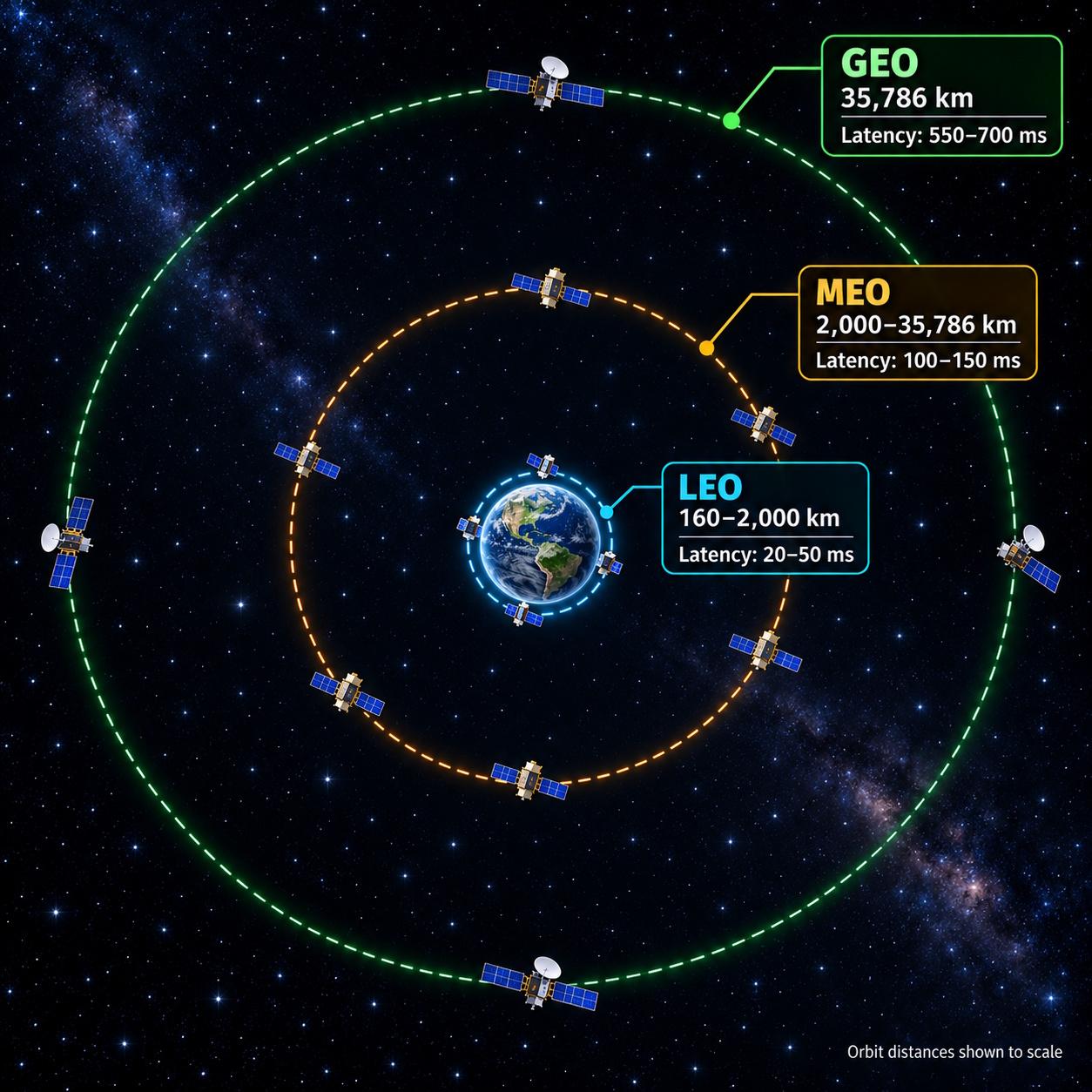
For decades, maritime communication relied on Geostationary (GEO) satellites operating 35,786 km above the equator. While GEO provides broad, persistent beam footprints, the travel distance creates a minimum ~600 ms round-trip latency—inhibiting modern cloud ERPs, real-time video, and interactive applications.
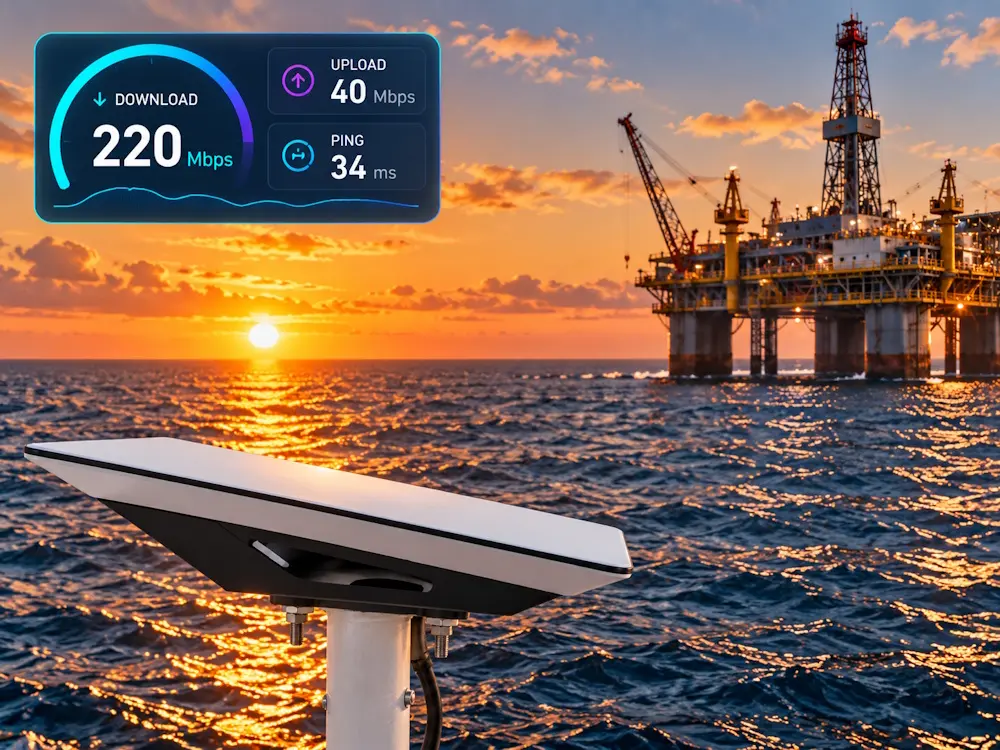
Low Earth Orbit (LEO) constellations orbit between 550 km and 1,200 km above Earth—over 30 times closer. This physical proximity cuts latency to under 50 ms and delivers data rates up to 220+ Mbps, providing an office-equivalent LAN experience at sea.
Starlink Maritime: Ultra-Fast Ocean Broadband
CORE STRENGHTS
- Up to 220+ Mbps download burst speeds across global ocean routes.
- Sub-99 ms latency ideal for heavy crew internet welfare, multi-user HD streaming, and shore-to-ship cloud backups.
- High-gain flat panel antennas with zero moving mechanical parts.
- Flexible priority data bundles
OneWeb: Enterprise Reliability & SLAs
CORE STRENGHT
- Polar-to-polar global coverage, including high-latitude northern routes.
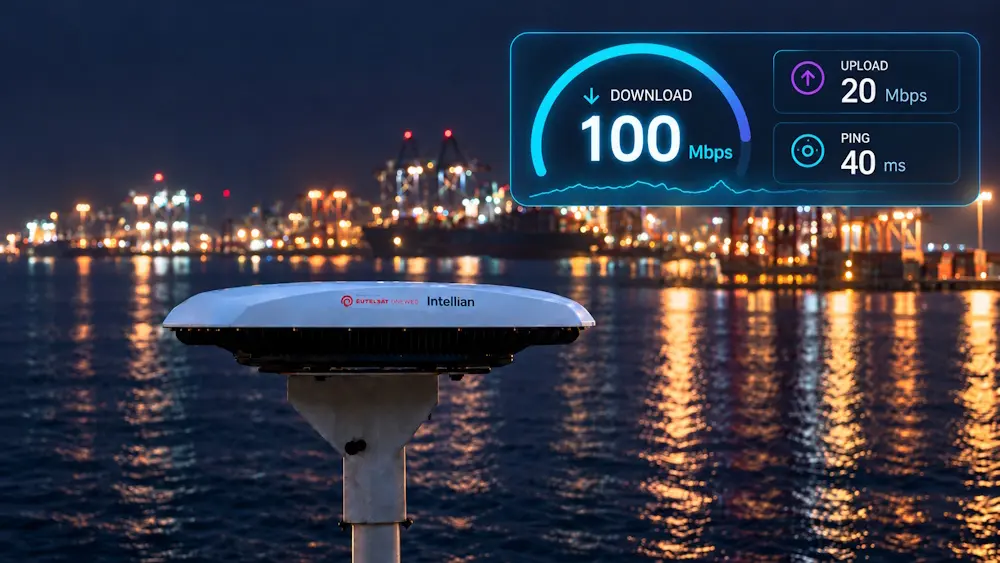
- Optional enterprise CIR packages with symmetrical up/down speeds.
- Enterprise-grade QoS prioritization for business-critical telemetry, engine IoT, and ECDIS synchronization.
- Choice of dual-parabolic tracking antennas or modern flat-panel arrays.
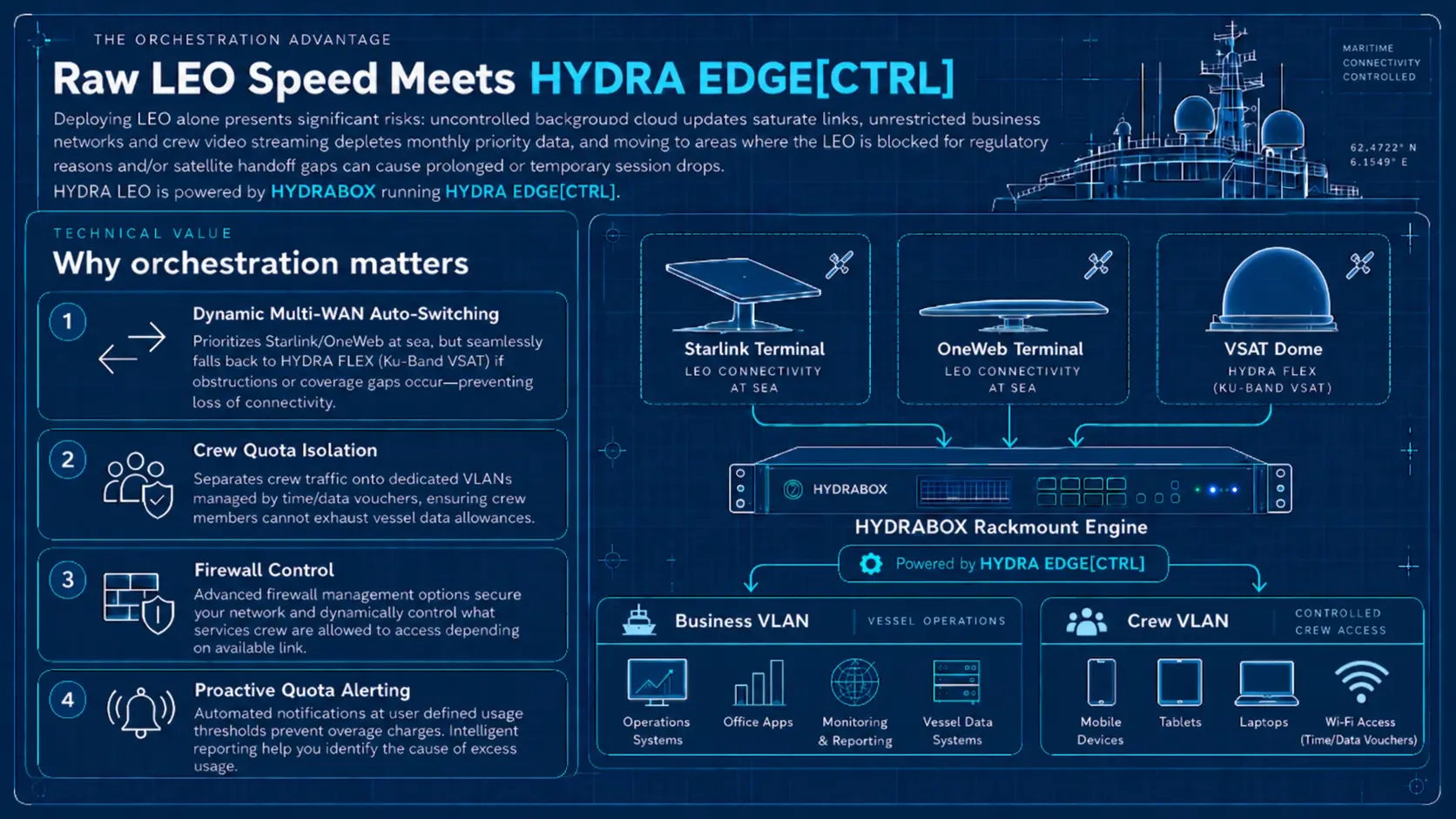 Explore EDGE[CTRL] features? See more
FAQ
Replacing VSAT?
Q: Can LEO completely replace our existing Ku-band VSAT system?
A: While LEO delivers higher throughput and lower latency, most commercial fleet operators retain HYDRA FLEX (Ku-band VSAT) as an active backup. Hybrid setups ensure regulatory compliance, provide backup where LEO is restricted, and guarantee uninterrupted operations across all maritime corridors.
Starlink vs OneWeb
Q: What is the main difference between Starlink Maritime and Eutelsat OneWeb?
A: Starlink is known for high asymmetric burst speeds (up to 220+ Mbps down) and cost efficiency for crew welfare. OneWeb is similar and delivery speeds up to 100Mbps down, OneWeb have enterprise offering with CIR guarantees, they also work in some countries where Starlink does not and vice verca. Both can be combined under Blue C Mobile’s HYDRA ONE management umbrella.
Overage Prevention
Q: How does Blue C Mobile prevent LEO overage fees?
A: HYDRA EDGE[CTRL] continuously monitors consumption across each WAN interface, sending proactive threshold alerts (user defined) and enforcing per-voucher data quotas for crew members. Aditionally we help you configure the business network to prevent unintended data usage for entertainment/social media.